
Introduction
The front-end framework debate continues to shape startup and enterprise decisions in 2025. Two frameworks—React and Vue—stand out as leaders. Both empower teams to build fast, scalable, and user-friendly applications. But when the decision directly impacts time-to-market, developer hiring, and long-term scalability, choosing between React and Vue isn’t just technical—it’s a business strategy.
This blog breaks down React vs Vue, covering pros, cons, key differences, and practical scenarios. By the end, you’ll know which framework best suits your project—and how Onboardnow can help you hire the right developers flexibly (hourly, part-time, or full-time) so that your project runs smoothly.
React and Vue: A Quick Overview
React is a JavaScript library created by Facebook, widely adopted across industries, powering platforms like Instagram, Netflix, and Airbnb. With a massive ecosystem and enterprise backing, React remains the most popular front-end technology worldwide.
Vue, created by Evan You, is a progressive framework praised for its simplicity and flexibility. It has seen rapid adoption in APAC markets and among startups that value speed and developer-friendly design. Vue powers platforms like Alibaba, Xiaomi, and GitLab.
Pros and Cons of React vs Vue
| Aspect | React Pros / Cons | Vue Pros / Cons |
| Popularity & Hiring | Pros: Vast global community and job market
Cons: Ecosystem can feel fragmented |
Pros: Enthusiastic APAC-focused community
Cons: Smaller global dev pool |
| Performance & Size | Pros: Mature virtual DOM
Cons: Can be heavy—requiring optimizations |
Pros: Lightweight, efficient reactivity
Cons: Less proven at very large-scale |
| Learning Curve | Pros: Familiar code patterns for JS experts
Cons: JSX and tooling can be steep |
Pros: Gentle learning path, intuitive syntax
Cons: Smaller enterprise-level hiring pool |
| Ecosystem & Tools | Pros: Massive library availability
Cons: Fragmented tooling options |
Pros: Cohesive official tooling (Vue Router, Pinia)
Cons: Fewer niche third-party libraries |
| Mobile & Cross-Platform | Pros: React Native is industry-proven Cons: Duplication for web vs mobile | Pros: Quasar/Nuxt enable cross-platform builds
Cons: Less widespread mobile adoption |
Quick Insights
- React: Its global popularity makes hiring easier in the US, Australia, and worldwide, though teams may struggle with too many library options.
- Vue: Smooth learning curve and integrated ecosystem make it great for lean startups and APAC markets, but enterprise hiring outside Asia can be tricky.
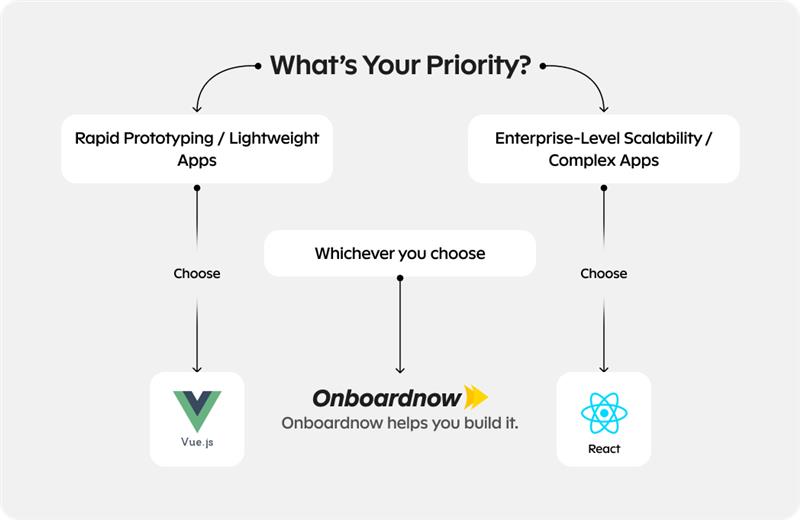
Key Differences Between React and Vue
Performance & Flexibility – What it means for app speed and complexity
React’s virtual DOM ensures predictable performance, ideal for applications with frequent UI updates. Vue’s lightweight reactivity system makes it faster for smaller apps but less tested for billion-user platforms.
Ecosystem & Community Support – Long-term stability
React wins in raw numbers—more developers, libraries, and enterprise backing. Vue offers official, cohesive tools like Vue Router and Pinia, reducing decision fatigue for small teams.
Learning Curve & Developer Availability – Hiring ease & costs
- React: Great fit if you need to hire globally, especially in the US and Australia.
- Vue: Better for APAC hiring markets where the talent pool is growing faster. Startups in global markets may find React developers more accessible and cost-efficient at scale.
Scalability & Enterprise Use Cases – Startups vs large-scale systems
- React: Built for large-scale, complex applications, with proven adoption across Fortune 500s.
- Vue: Perfect for fast MVPs, prototypes, and regional apps, but enterprise adoption remains lower outside Asia.
When to Choose React
- You’re targeting global markets (US, AU, EU) with a need for large developer pools.
- Your project involves scalable, complex apps—think marketplaces, SaaS platforms, or social media.
- You need strong mobile support via React Native.
If you’re ready to scale with React, you can hire React developers to build robust, future-ready applications.
When to Choose Vue
- You’re a startup or SMB focused on fast MVP launches.
- Your team values simplicity, flexibility, and fewer tooling decisions.
- You operate in APAC markets where Vue adoption and developer availability are growing rapidly.
Need lightweight, flexible apps? You can hire Vue developers for fast, affordable solutions
React vs Vue: Which Should Your Business Choose with Onboardnow?
At the end of the day, your framework choice depends on business goals, hiring market, and scale. React offers global reach, proven scalability, and deep community backing. Vue provides speed, simplicity, and integrated tooling.
But whichever you choose, the real challenge is hiring the right developers—quickly and flexibly. That’s where Onboardnow comes in.
- Hire React or Vue developers on an hourly, part-time, or full-time basis.
- Access vetted global talent pools to match your project needs.
- Scale teams flexibly as your app grows from MVP to enterprise ready.
Conclusion
In 2025, the React vs Vue debate is less about which is “better” and more about which aligns with your business model, market, and growth plans. React dominates globally, offering enterprise-scale solutions and a vast hiring pool. Vue thrives in startup and APAC ecosystems, enabling rapid development with simplicity.
The smartest move? Align your framework choice with your business strategy. Whether you go with React or Vue, you can easily hire the right developers to scale your project with confidence.
FAQs
Is React still more popular than Vue in 2025?
Yes. React continues to dominate globally, especially in the US and Australia, though Vue is growing fast in APAC.
Which is faster—React or Vue?
For small to medium apps, Vue often feels faster. For complex apps, React’s mature optimizations hold up better.
Can I switch from Vue to React (or vice versa) later?
Yes, but migration costs are high. It’s best to align your choice with long-term goals.
Which is better for startups—React or Vue?
Vue is often the choice for faster MVPs, while React fits startups planning global scale.
How can I hire React or Vue developers quickly?
Onboardnow offers flexible hiring models—hourly, part-time, or full-time—to help you scale your team with vetted developers.